Real-world answers to textbook questions: how PBL is changing classrooms
If you ask a child what they learned in school today, they will usually hand you a textbook or their class notes, with a chapter name or a formula copied from the board. They are learning to remember. But are they learning to understand?
At Caring with Colour, a Manasi Kirloskar Initiative, we believe real learning happens when a child looks at a lesson and asks, "How does this connect to my life?"
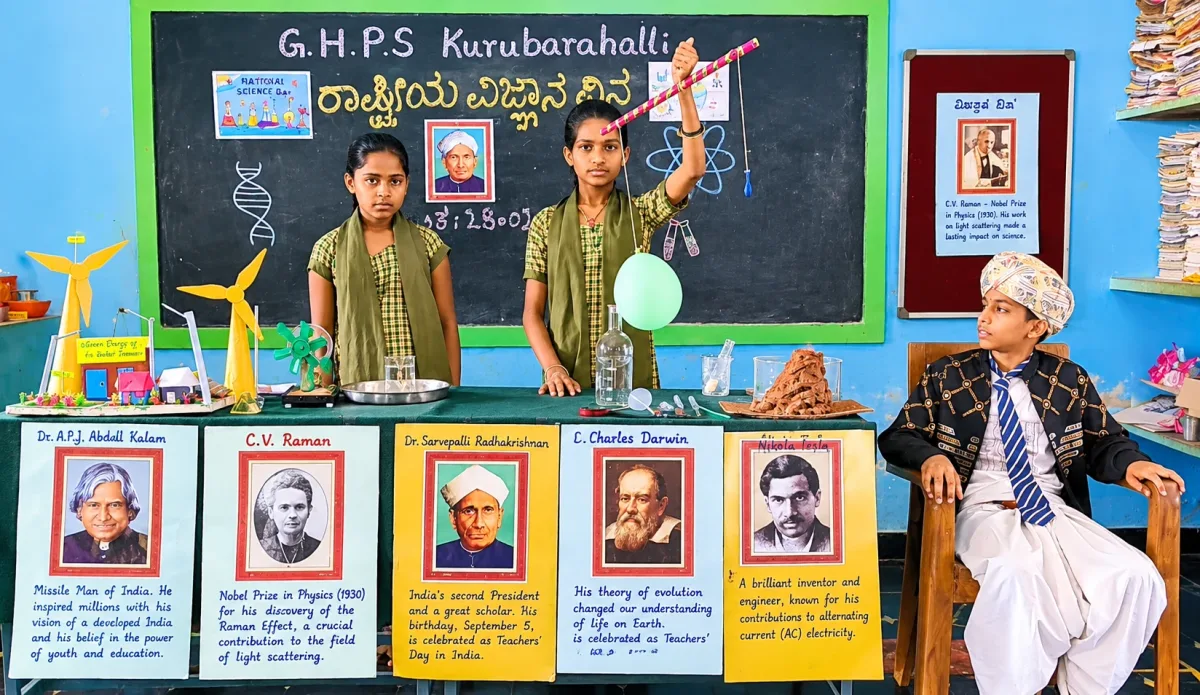
To bridge the gap between abstract theory and the real world, we bring Project-Based Learning (PBL) into rural government schools. It is an approach centred on students, wrapped in a simple, ancient philosophy: Involve me, and I understand. Instead of treating children as passive listeners, PBL turns them into active researchers who explore real world challenges through hands-on inquiry.
It all starts with a driving question
Traditional schooling often front-loads answers to questions children never asked. Our PBL model flips this. Every project begins not with a lecture, but with a Central Driving Question that acts as a mystery to solve.
How clean is the water in our village, and how can we protect it?
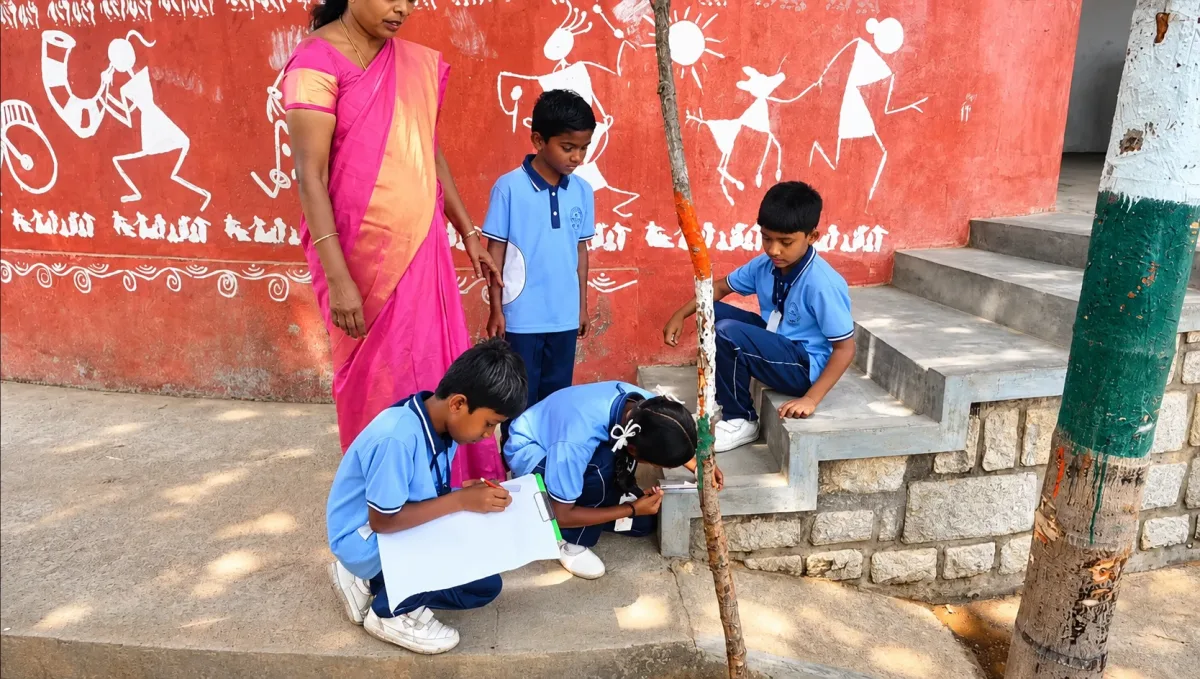
A textbook chapter on pollution becomes a living problem. Suddenly, math isn't just numbers on a page; it's a tool for calculating data percentages. Science isn't just a diagram; it's a practical method for testing local water quality. By grounding lessons in local realities like waste management or village agriculture, learning stops being a rigid requirement and becomes a joyful, deeply relevant experience.
Activating the 4 Cs
The modern world rarely tests us on our ability to memorize; it tests our ability to adapt and solve problems. Our framework weaves the "4 Cs" of 21st-century education into every project:
- Critical thinking: When an experiment doesn't go as planned, students analyze the data, troubleshoot the errors and evaluate the evidence.
- Collaboration: Working in small teams, children learn negotiation, shared responsibility and peer mentoring.
- Communication: At the end of every project, learners present their findings to classmates, building the confidence to explain complex ideas clearly.
- Creativity: With no single "correct answer" to follow, students design their own models and experiments using everyday, local resources.
Engineered for the realities of rural schools
Many experiential learning programs look beautiful on paper but collapse under the pressures of a rural government school. We built our PBL model to work within those constraints.
Depth over speed
Our curriculum skips the rush through hundreds of textbook pages and focuses on seven in-depth projects per subject per year, roughly one a month. This pacing gives children the breathing room to reflect, revise and truly master core concepts.
Flexing for multigrade classrooms
Rural educators frequently manage multigrade classrooms where several age groups share one space. Our PBL framework handles this by design. During a single village waste management project, older students can dive into scientific and data principles, while younger peers focus on foundational observation and basic categorization, all within the same team.
Supporting teachers as mentors
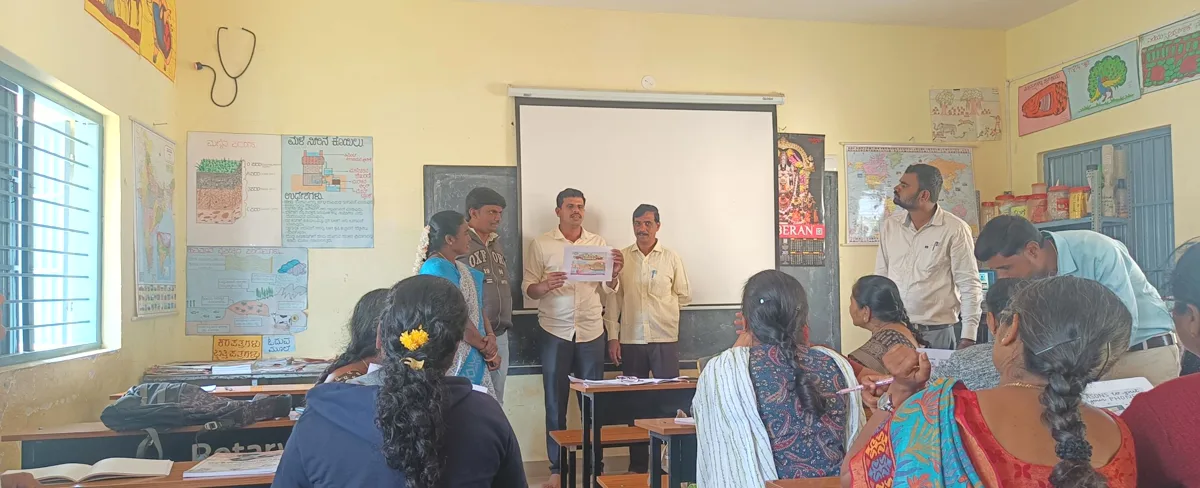
Stepping away from the chalkboard to become a classroom facilitator can be daunting. Our program gives teachers structured guides that walk them through each step and act as a safety net.
We also replace stressful one-time exams with continuous assessment based on rubrics. This lets teachers measure holistic progress, tracking not just academic facts but the growth of empathy, values and social and emotional maturity.
Preparing tomorrow's leaders
Project-Based Learning is more than a clever academic strategy; it is a movement to ignite a lifelong scientific temperament. By empowering rural students to take charge of their own learning today, we are preparing them to step up as the responsible, innovative and empathetic leaders India needs tomorrow.
Curious to see what happens when learning leaves the textbook? Explore our PBL program.
See the PBL implementation model
Seven in-depth projects per subject, per year, built for rural classrooms.
Explore PBL →